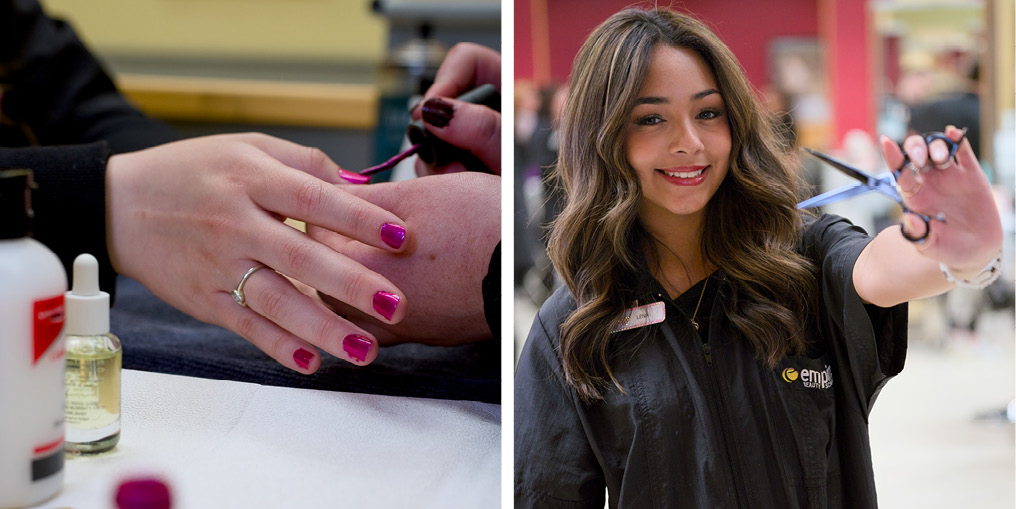
A nail technician focuses on nail care. A cosmetologist receives broader training that covers hair services, nail care and basic skin care. Both paths offer opportunities to use creativity while working directly with clients. The right choice depends on the services you want to provide and the licensing requirements in the state where you plan to work.
If you’re considering Empire Beauty School, note that it doesn’t currently offer a dedicated nail technology program. However, you can learn nail-care skills as part of its cosmetology curriculum.
What Does a Nail Technician Learn?
A nail technician improves the care and appearance of their clients’ fingernails and toenails. A manicurist focuses on fingernails, while a pedicurist focuses on toenails. They help clients choose nail shapes, colors and designs that meet their expectations.
The work combines attention to detail with the ability to listen to a client’s preferences and explain available services. Common manicurist and pedicurist responsibilities include:
- Cleaning, trimming, filing and shaping nails
- Applying and removing nail polish
- Applying or removing artificial nails and nail art
- Providing hand and foot care as part of manicures and pedicures
- Explaining how clients can care for their nails between appointments
Nail technology training focuses on these services and the practices needed to perform them safely. Sanitation and proper tool use are essential, along with the creativity needed for nail design.
What Does a Cosmetologist Learn?
Cosmetology training covers several areas of beauty services. Haircutting, styling, coloring and texture services are major parts of the curriculum, along with nail care and basic skin care. At Empire Beauty School, the cosmetology program also includes communication and marketing skills that help you prepare to work with clients.
This broader education gives you the opportunity to explore different interests. One person may want to learn about hair color, but then discover an interest in nail design. Another student might want to provide several services in a salon. The broader scope of the cosmetology program allows you the chance to determine what area appeals most to you.
How Do Licensing Requirements Differ?
Nail technology and cosmetology typically have separate licensing paths, with different training and examination requirements. A program focused on nails generally requires fewer training hours than a broader cosmetology program. However, you should check the requirements for the specific credential you plan to pursue.
Before enrolling, you should ask the school and your state licensing agency about required training hours, examinations, age and education requirements, and the services covered by each credential.
Can You Learn Nail-Care Skills at Empire Beauty School?
Yes. Empire’s dedicated nail program is not currently offered. However, the school lists nail-care skills within its cosmetology program, including manicuring, pedicuring, gel manicuring, acrylic enhancements and nail art.
Students interested in nails should understand that they would be enrolling in a broader cosmetology program that also covers hair and basic skin care. Before choosing a campus, ask an admissions representative about its curriculum, the nail services students practice and the licensing path the program supports.
Which Path Fits Your Career Interests?
Making the choice between pursuing a nail technician or cosmetologist career depends on your goals. A good place to start is by considering the services you would most like to provide. If your goal is to focus exclusively on manicures, pedicures and nail design, a dedicated nail technology program may align with that interest. If you want to learn nail design techniques along with haircutting, coloring, styling and other beauty skills, cosmetology offers a broader foundation.
A broad education can still support a focused career interest. Empire’s beauty career paths include nail design, and the school notes that nail services can become a professional’s main focus or complement other salon services. Compare the curriculum, time commitment and licensing requirements with the work you hope to do.
To learn more about studying cosmetology at Empire Beauty School, contact an admissions representative or schedule a visit. Ask how nail-care training fits into the program and what steps graduates must take to pursue licensure in your state.
Frequently Asked Questions
Is a nail technician the same as a cosmetologist?
No. A nail technician specializes in nail services. A cosmetologist completes broader training that includes hair services and basic skin care as well as nail care.
Can a cosmetologist focus on nail services?
Yes. Nail design can be a career focus for a cosmetologist. Professionals should confirm which services their state license permits them to perform.
Does Empire Beauty School currently offer a separate nail technology program?
No. Empire’s dedicated Nail Technology Program is not currently offered. Its cosmetology curriculum includes nail-care skills.
Does nail technology require the same training hours as cosmetology?
Not necessarily. The two credentials can have different hour requirements, with nail technology generally requiring fewer hours. Requirements vary by state.
Does graduating from beauty school mean you are licensed?
No. Graduates must satisfy their state’s licensing requirements before providing services that require a license.