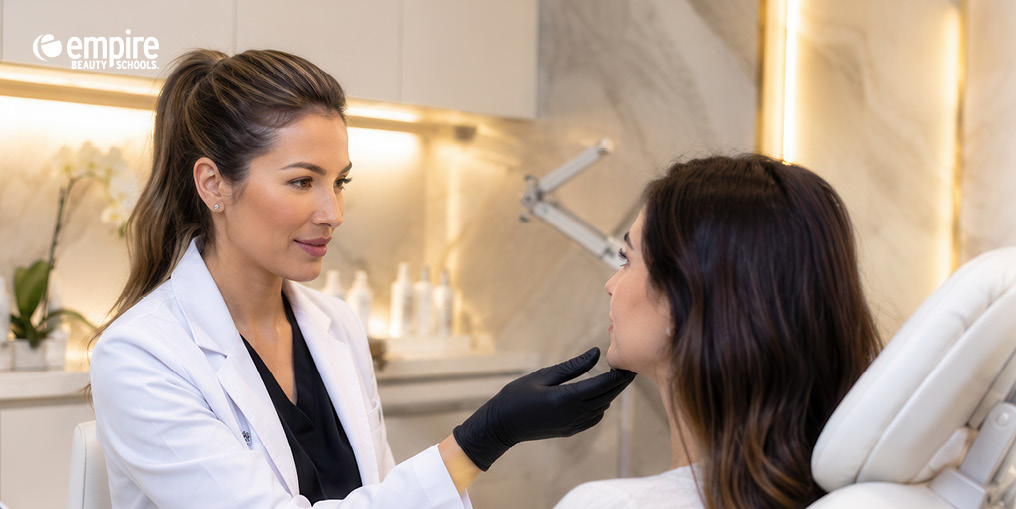
A facial specialist focuses on helping clients care for their skin. Their work begins with a conversation: What does the client want from the visit? Do they have sensitivities or concerns the specialist should know about? From there, a facial specialist assesses the skin and provides services such as cleansing, exfoliating and treating the skin on a client’s face and neck.
The goal of a facial specialist is to improve the appearance and condition of a client’s skin. The role overlaps with that of an esthetician, although the credentials and permitted services can differ by state.
For those interested in skincare but unsure which beauty career to pursue, it helps to look at what facial specialists do each day.
What Services Does a Facial Specialist Provide?
Facial specialists offer services that vary by location and state. Some of the most common services include:
- Facials: Cleansing and other treatments selected for a client’s skin.
- Skin analysis: Looking at the skin and discussing concerns before recommending a service or products.
- Hair removal: Services such as waxing, where permitted.
- Makeup application: Applying makeup for everyday wear or special occasions.
Some facial specialists also offer services such as microdermabrasion or chemical peels when their training and state rules permit them. Whatever the service, the job calls for careful sanitation, clear communication and attention to the client’s comfort.
Where Can Facial Specialists Work?
Some facial specialists work in salons or spas that offer skincare services. Others pursue roles in beauty education or as skincare and makeup consultants. The setting affects the day-to-day work: A spa specialist might spend much of the day providing treatments, while a consultant may spend more time helping customers understand products.
In any setting, the ability to work well with people is key to success. You need to listen to clients, explain what a service involves and help them feel comfortable asking questions.
How Is Facial Specialist Training Different From Cosmetology?
A facial specialist program offers a focused path into skincare. You may also see this training described as an esthetician program. In Florida, the credential is called “facial specialist,” although practitioners may call themselves estheticians. At Empire’s West Palm Beach, Florida, location, the 220-hour facial specialist program combines classroom learning with clinic training. Students study skin analysis and services such as facials, waxing and makeup application.
A cosmetology program covers a wider range of beauty services, particularly hair, along with skin and nail care. Program names, required hours and the services graduates may perform depend on the state, so compare local requirements before choosing a path.
Can You Practice Working With Clients in Beauty School?
Practice helps you bring together your technical skills and client care. At Empire, students learn in supervised practice environments, including student salons and clinics where they can work with guests. That experience gives you a chance to conduct consultations, perform services and respond to instructor feedback.
You can read more about what Empire Beauty School offers its students.
Is a Facial Specialist Career Right for You?
If you enjoy skincare and working directly with people, facial specialist training may be a good option to explore. Start by comparing the services you want to provide with the training and credentials your state requires. You can also learn about Empire Beauty School’s Facial Specialist program to see what its focused curriculum includes.
Frequently Asked Questions
Is a facial specialist the same as an esthetician?
The terms and credentials vary by state. Both roles involve skincare, but a facial specialist program may have a narrower curriculum and different training requirements than an esthetics program.
Do facial specialists only give facials?
No. Depending on their training and state rules, they may also perform skin analysis, hair removal and makeup application.
Do facial specialists need a license?
Requirements depend on the state. Check your state’s rules for the credential and services you plan to pursue before enrolling in a program.
How long does it take to become a facial specialist?
The time depends on your program’s required training hours and class schedule. Empire Beauty School’s West Palm Beach Facial Specialist program includes 220 hours of training. Contact the campus for its current schedule and expected completion time.
Do you need skincare experience before starting a facial specialist program?
You do not typically need professional skincare experience to begin training. A facial specialist program introduces skincare concepts and gives you opportunities to practice service techniques. Check with your chosen school about its admission requirements.